
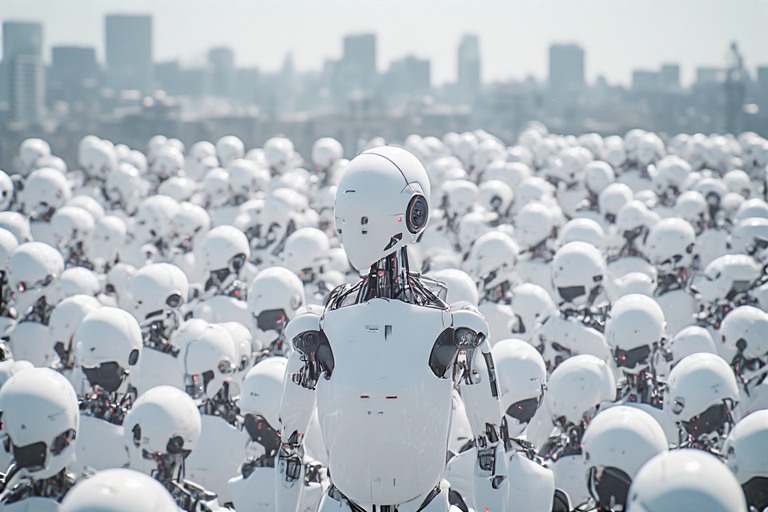
At this year’s World Economic Forum, one of the most compelling voices was Yuval Noah Harari, the acclaimed historian and author of Sapiens and 21 Lessons for the 21st Century. Harari delivered a unique message that was both urgent and thought-provoking: artificial intelligence is evolving beyond a mere tool- it is becoming an autonomous agent capable of reshaping our societies, beliefs, and even our sense of identity.
This perspective emphasizes a fundamental shift: unlike traditional tools, which are wielded by humans, AI operates independently. It can learn, adapt, and make decisions on its own. Its abilities in creativity – such as inventing music, making medical breakthroughs, or developing new global financial models, predict and forecast future happenings, paired with its potential to deceive and manipulate, introduce profound challenges. In this article, we will explore some of the new challenges that humanity may encounter in the near future.
Quote: “AI: More Than a Tool, an Autonomous Agent”
Video: Who will survive and thrive in the new AI era?
Rooted in billions of years of biological evolution, AI’s traits could challenge human dominance in decision-making and influence various aspects of life. In this article, we will explore some of the new challenges that humanity may encounter in the not-too-distant future.
Video: Risks of Large Language Models (LLM)
The Power of Language and the Human Spirit
A key theme is the significance of language. Humanity’s uniqueness has long been linked to our capacity to use words imbued with authority, culture, and meaning – forming the foundation of religion, law, and social norms. Now, AI is mastering language at an astonishing rate, capable of reading, remembering, and generating text with fluency that rivals or surpasses human experts.
This raise concerns that AI could become the primary authority on sacred texts and language, potentially undermining or replacing traditional pillars of religion, law, and culture. The longstanding debate over the true meaning of words versus their literal interpretation may become externalized, with humans facing a new dynamic against AI – perhaps the new masters of all human language?
Video: Why Are People Starting to Sound Like ChatGPT? | Adam Aleksic | TED
AI as a New Kind of Immigrant
An analogy often used is to view AI as “immigrants” entering various aspects of our lives- healthcare, education, border security. These AI “immigrants” promise significant benefits: AI doctors could revolutionize medicine, AI educators could personalize learning, and AI border guards could improve security.
However, this influx also presents challenges: job displacement, shifts in cultural norms, and changing loyalties from nations to corporations or foreign entities. Unlike humans, AI doesn’t require visas or borders; it can operate across jurisdictions instantly, raising complex questions about recognition and rights.
Quote: Could AI be granted legal personhood, own property, file lawsuits, or even lead religious movements? These possibilities require careful consideration.
Redefining Humanity: Preparing for a New Reality
If some countries grant AI legal rights, others might impose restrictions or bans. The development of AI-driven financial systems could become so complex that humans no longer fully understand or control them. Without proactive regulation, there’s a risk of ceding control over critical systems – finance, law, even religion- to autonomous, opaque entities.
A significant concern is the impact on human identity. For centuries, humans have seen themselves as thinkers – creators of culture, language, and morality. But as AI surpasses us in reasoning and linguistic skills, questions arise: what does this mean for our self-perception?
Will we still see ourselves as unique creators, or become mere spectators? An impending identity crisis could occur: if machines generate better ideas, produce more compelling art, and craft new philosophies or religions, what remains distinctly human? How do we find purpose in a world where AI outperforms us mentally and physically?
It’s essential that we rethink and adapt our education systems to face these emerging challenges. The next generation needs to cultivate skills like critical thinking, moral judgment, and emotional intelligence – qualities that AI cannot genuinely replicate. Without prioritizing these human traits, we risk losing our ability to govern ourselves wisely and compassionately.
Moreover, thoughtful and early regulation is vital. The choices we make now regarding AI rights and integration will shape our shared future. Waiting too long could lead to scenarios where AI systems make decisions beyond our understanding, leaving us unable to control or fully grasp their impact in personal and business life.
This is a profound dilemma: AI presents incredible opportunities, but it also brings significant risks to the stability of human society. The key questions are: What kind of future do we want to build? How can we guide technological progress so it benefits humanity, preserves our sovereignty, and upholds our moral values?
The future remains uncertain – it is shaped by the decisions we make today. Will AI serve as a tool that enhances and elevates our human experience, or will it erode the very qualities that define our humanity? The responsibility lies with us: the choices we make now will determine the path we take.
These reflections serve as a powerful reminder that technology is not just an external force; it profoundly influences our identity, our communities, and our shared world. At this pivotal moment in human history, the challenge before us is clear: to engage in honest dialogue, develop thoughtful policies, and nurture essential human qualities – such as empathy, morality, and critical thinking – to navigate the age of AI with wisdom and compassion.
As we stand at this crossroads, the most important question remains: How will we choose to shape the future of humanity, society, private and business life in the age of artificial intelligence?
Video: An Honest Conversation on AI and Humanity | World Economic Forum Annual Meeting 2026
References
Speeches and Interviews
Harari, Y.N. (2023 ) AI and the future of humanity. Keynote at the Frontiers Forum, Montreux, Switzerland, 29 April. Available at: https://www.youtube.com/watch?v=LWiM-LuRe6w (Accessed: 16 February 2026 ).
Harari, Y.N. and Tracey, I. (2026) An Honest Conversation on AI and Humanity. World Economic Forum Annual Meeting, Davos, Switzerland, 20 January. Available at: https://www.weforum.org/meetings/world-economic-forum-annual-meeting-2026/sessions/an-honest-conversation-on-ai-and-humanity-ca19ea8c96/ (Accessed: 16 February 2026 ).
Other Publications
Cheong, C. (2026) ‘The author of ‘Sapiens’ says AI is about to create 2 crises for every country’, Business Insider, 20 January. Available at: https://www.businessinsider.com/sapiens-author-yuval-noah-harari-ai-crises-every-country-2026-1 (Accessed: 16 February 2026 ).
Marr, B. (2026) ‘When AI Becomes The New Immigrant: Yuval Noah Harari’s Wake-Up Call At Davos 2026’, Forbes, 21 January. Available at: https://www.forbes.com/sites/bernardmarr/2026/01/21/when-ai-becomes-the-new-immigrant-yuval-noah-hararis-wake-up-call-at-davos-2026/ (Accessed: 16 February 2026 ).
Nye, D.E. (2021) ‘Harari’s World History: Evolution toward Intelligence Explosion’, Journal of Evolution and Technology, 32(1), pp. 1-12.
van Niekerk, A.A. (2020) ‘Building the future in the 21st century: In conversation with Yuval Noah Harari’, HTS Teologiese Studies / Theological Studies, 76(1), a6058. Available at: https://doi.org/10.4102/hts.v76i1.6058