
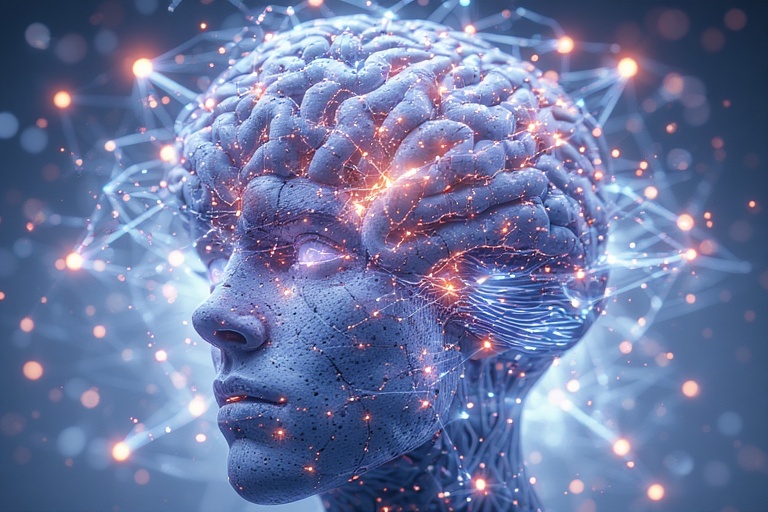
Imagine teaching a child how to recognize animals, play chess, or speak a new language. Over time, through experience, feedback, and practice, they improve and become more skilled. Now, picture machines doing the same – learning from data, adapting to new challenges, and becoming smarter with each interaction. This is the essence of how artificial intelligence (AI) agents learn, and it’s a fascinating story rooted in science, mathematics, and an ever-growing understanding of intelligence itself.
AI’s ability to learn is what makes it so powerful and versatile. From virtual assistants like Siri and Alexa to self-driving cars and medical diagnosis systems, AI agents are increasingly capable of performing complex tasks that once seemed solely human. But how do these digital beings learn? What scientific principles guide their growth? And what does the future hold for their evolving intelligence? Let’s explore the science behind how AI agents learn – uncovering the secrets that enable these machines to think, adapt, and sometimes surprise us.
(Video: Screaming AI chatbot claims she is conscious?)
Alright, What Exactly is the Concept Behind Machine Learning?
At its core, machine learning is about teaching computers to recognize patterns and make decisions based on data. Instead of programming every rule explicitly, we provide the machine with examples – large amounts of data – and let it discover the underlying rules and patterns itself. Think of it as showing a child hundreds of pictures of cats and dogs, and gradually, they learn to tell the difference. That’s essentially what machine learning does: it enables a computer to learn from experience.
AI systems learn in different ways, depending on what we want them to do:
- Supervised Learning: Like a student with a teacher’s guidance, the AI is trained on labelled data – images tagged as “dog” or “cat,” for example. Over time, it learns to classify new images accurately.
b. Unsupervised Learning: Think of a child exploring a new city without a map – discovering patterns and groupings on their own. In this case, the AI finds structures in unlabelled data, such as grouping customers by purchasing habits.
c. Reinforcement Learning: Imagine training a pet by rewarding good behaviour. Here, an AI learns by interacting with its environment, receiving rewards for desirable actions and penalties for mistakes. This approach is used in teaching robots to walk or in game-playing AI like AlphaGo.
(note: more interesting models: https://www.youtube.com/watch?v=0YdpwSYMY6I)
Data is the foundation of learning. The more diverse and high-quality the data, the better the AI can understand the world. Just as a person needs varied experiences to become well-rounded, AI models need extensive data to generalize well and avoid mistakes.
Alright, let’s explore what Power AI Learning is: Inspired by the brain – neural networks.
One of the most influential ideas behind AI learning is the neural network – a system designed to mimic the brain’s interconnected neurons. Imagine thousands or millions of tiny decision-makers working together, passing signals and adjusting their connections based on success or failure. These artificial neurons learn by changing the strengths of their connections through a process called backpropagation, gradually improving their ability to recognize patterns.
What is backpropagation?
Imagine you’re playing a game where you’re trying to throw a ball into a basket. At first, you miss, but you learn from where the ball landed and how to throw better next time. Backpropagation is like that learning process for computers. When a computer tries to solve a problem, it makes a guess. If it’s wrong, backpropagation helps it learn from its mistake by telling it how to change so it can do better next time. It’s like giving the computer hints to improve its guessing.
(Video: Neural Network In 5 Minutes | What Is a Neural Network?)
Cutting-Edge Techniques in AI Learning
Training an AI model is like trying to find the best route through a maze. Mathematicians use techniques like gradient descent to adjust the model’s parameters step-by-step, minimizing errors and honing accuracy. Think of it as tuning a musical instrument until it sounds just right—the process involves continuous adjustments guided by mathematical formulas.
A common challenge is making sure the AI doesn’t just memorize the training data but truly understands the underlying patterns. If it memorizes every detail, it might do well on known data but fail on new, unseen data. To prevent this, scientists use techniques like regularization and cross-validation – akin to studying in a way that prepares you for any exam question, not just the ones you’ve seen before.
Deep learning is a breakthrough that involves training neural networks with many layers – hence “deep.” These deep networks can automatically learn features from raw data, such as identifying objects in images or understanding speech. It’s like a child learning to recognize complex patterns without needing explicit instructions for each step.
Reinforcement Learning in Action
Reinforcement learning has achieved impressive feats, like teaching AI to master games like chess or Go, often surpassing human champions. This approach allows machines to develop strategies by exploring many possibilities and learning from their successes and failures – much like how humans learn through trial and error.
One of the most exciting developments is enabling AI to transfer knowledge from one task to another, or to learn from just a few examples. Imagine showing a child a single picture of a new animal, and they can recognize it in the future. These techniques bring AI closer to human-like learning efficiency.
As AI systems grow more complex, understanding how they arrive at decisions becomes more difficult. This raises concerns about trust and accountability. Researchers are working on explainable AI tools that help us peek inside the “black box” and understand the reasoning behind AI’s choices.
(Video: Explainable AI vs. Black Box AI (Opaque AI))
AI learns from data, but if that data contains biases, the AI might perpetuate or amplify unfair stereotypes. Ensuring fairness requires careful data curation and developing algorithms that detect and mitigate bias – a critical step toward ethical AI.
The Future of AI Learning
The journey to understand how AI learns is still in its early stages, but the road ahead is full of promise and potential. Over the coming years, we can expect AI systems to become more adaptable, transparent, and aligned with our core values and daily needs. For instance, picture AI assistants that grasp the full context of a conversation, offering helpful advice without requiring endless amounts of data. Or think about AI tools that can learn new skills quickly from just a few examples – much like how humans can master a task in minutes rather than days.
Breakthroughs in neuroscience, cognitive science, and computer science are coming together to develop smarter AI machines that not only imitate human thought processes but also work alongside us to enhance our abilities and improve our quality of life. Imagine AI helping doctors diagnose diseases more accurately by understanding complex patient histories, or educational apps that adapt instantly to each student’s learning style, making education more personalized and effective.
As researchers continue to explore how our brains process information, they’re applying those insights to create algorithms that learn more like humans – flexibly, efficiently, and in context. This progress could lead to robots working seamlessly alongside us in factories or virtual assistants that anticipate our needs before we even voice them.
(M1: The World’s First Wheeled Quadruped Robot with Paralleled Joints)
Of course, there are challenges to address – ethical considerations, fairness, and avoiding unintended biases. But the advancements so far point toward a future where AI learns more like us, adapts swiftly to new situations, and supports us in ways we’re only beginning to imagine. The science behind AI learning is not just about machines—it’s about understanding intelligence itself, and our place in a new reality.
Further references
But what is a neural network? | Deep learning chapter 1
Neural Networks Explained in Five Minutes (by IBM)
Large Language Models explained briefly
Large Language Models Are Improving Exponentially: In a few years, AI could handle complex tasks with ease
https://spectrum.ieee.org/large-language-model-performance
What’s in a humanoid hand? | Boston Dynamics