

As 2025 comes to an end, we’re witnessing a major turning point in the world of artificial intelligence. The industry is moving beyond the era of generative AI – where models simply respond to prompts – and entering a new phase led by agentic AI. These sophisticated systems can think independently, plan ahead, and carry out complex, multi-step tasks to achieve specific goals, all with minimal human intervention. This isn’t just a simple upgrade; it’s a fundamental shift in how we interact with technology – transitioning from issuing commands to automating entire workflows.
In this article, we’ll delve into what’s happening in the world of AI agents in late 2025, supported by recent reports and real-world examples. We’ll explore how these breakthroughs are transforming industries like enterprise operations, B2B sales, healthcare, and commerce – and discuss what businesses need to do to stay ahead in this rapidly evolving landscape.
It’s evident that companies are moving beyond mere experimentation. A recent report from Cisco highlights this momentum, with Jeetu Patel, Cisco’s President and Chief Product Officer, stating, “We’re leaving behind the era of question-answering chatbots and entering a new phase of AI: autonomous agents that can independently execute tasks” [1].
The Agentic Shift: A Market Accelerating at Breakneck Speed
The adoption of AI agents is happening faster than many of us anticipated. Gartner has declared agentic AI as the top strategic technology trend for 2025, a prediction backed by a surge in market data and recent surveys from the past two quarters [2]. According to Cisco’s 2025 AI Readiness Index – a global survey of over 8,000 senior leaders – an impressive 83% of organizations are planning to deploy AI agents, with nearly 40% expecting these systems to work alongside human employees within the next year [1]. Companies are backing up this momentum with significant investments. Market forecasts from McKinsey & Company estimate that agentic commerce alone could bring in between $3 trillion and $5 trillion in global revenue by 2030 [3].
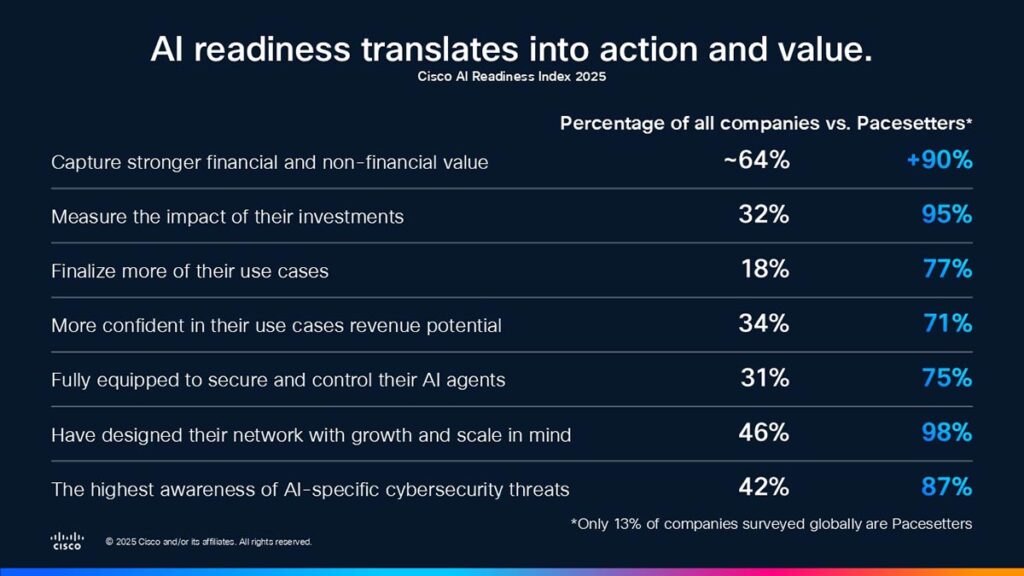
Okay, so what’s driving this rapid shift? The benefits are clear. A report from Boston Consulting Group (BCG) highlights that effective AI agents can speed up business processes by 30% to 50%, turning static technology platforms into dynamic, self-optimizing ecosystems [4]. The table below offers a snapshot of how prepared enterprises are for this technological revolution and what they’re aiming for with these transformative tools.
| Metric | Statistic | Source |
| Organizations planning to deploy AI agents | 83% | Cisco AI Readiness Index 2025 [1] |
| Expect agents to work alongside employees (within 1 year) | ~40% | Cisco AI Readiness Index 2025 [1] |
| Enterprises actively adopting AI agents | 90% | September 2025 Industry Survey [5] |
| Expected business process acceleration | 30-50% | BCG Report [4] |
| Projected global agentic commerce revenue by 2030 | $3-5 Trillion | McKinsey & Company Report [3] |
The biggest shift AI agents are bringing to businesses today is happening right at the core of their operations. Unlike earlier AI tools that helped with specific tasks, modern agent-based systems can now manage entire workflows. This change is unlocking new levels of efficiency and productivity, moving companies from simply supporting work to actually orchestrating it with AI taking the lead.
A Real-World Example: Gilion’s “Agent Army”
A great example of this transformation comes from Gilion, a Swedish finance company. As highlighted in a November 2025 Forbes article, Gilion has built an impressive “army” of 82 specialized AI agents to revolutionize their investment analysis process [6].
Their system pulls data from payments, marketing, accounting, and product usage, and then analyses it to produce accurate 12-month forecasts with a 90% success rate.
Henrik Landgren, Gilion’s co-founder and Chief Product & Technology Officer, explains that their goal isn’t about replacing entire jobs but about automating specific, targeted tasks. Their approach is straightforward: each AI agent is assigned a narrow, specialist role – like a team of experts – reporting their findings up through a hierarchy. All this information is then compiled into a detailed investment memo, which a final agent turns into an easy-to-understand, interactive report. This setup not only boosts efficiency but also minimizes human bias, resulting in more objective and trustworthy investment decisions. The Forbes article also shares lessons from companies like Klarna, which initially tried to automate entire roles and later found they needed humans to step back in to fill the gaps left by AI.
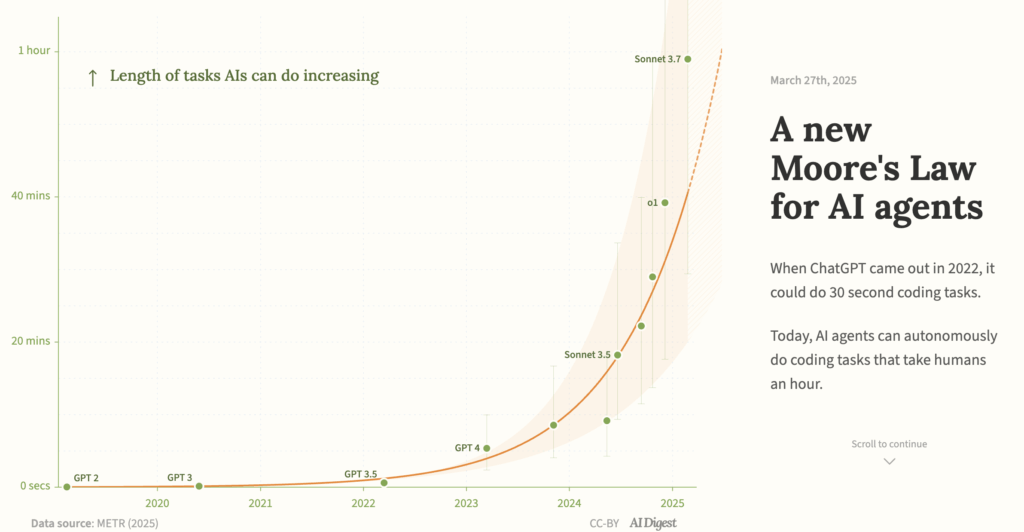
Source: AI Digest, link: https://theaidigest.org/time-horizons
A Blueprint for Transforming Enterprises
Gilion’s success isn’t just luck – it’s the result of a disciplined, strategic approach that combines a clear vision with a solid infrastructure. The Cisco AI Readiness Index highlights a group of high-performing organizations, called “Pacesetters,” who are four times more likely to move their AI pilots into full-scale production and are 50% more likely to see real results [1]. Their secret lies in several key pillars:
- Strategic Integration: AI isn’t an afterthought; it’s woven into their core business plans, with clear roadmaps, change-management strategies, and dedicated budgets.
- Infrastructure Readiness: These leaders have built flexible, scalable networks capable of supporting complex AI workloads — with 71% reporting fully adaptable networks, compared to just 15% of other companies [1].
- Security by Design: Recognizing that AI brings new security challenges, they embed security into their AI systems from the start. About 75% are fully equipped to manage and secure their AI agents, compared to only 31% of their peers [1].
However, the report also warns about a looming risk called “AI Infrastructure Debt.” This is the buildup of underfunded or compromised systems that could threaten AI’s long-term value. With 62% of organizations expecting workloads to grow by over 30% in the next three years and 64% struggling to centralize their data, neglecting foundational infrastructure could become a major obstacle for many companies trying to stay ahead.
(Video: Advancing Agentic Commerce)
Agentic Commerce, AI-Driven Interactions: A Future of Personalized, Seamless Shopping
AI agents aren’t just changing the behind-the-scenes operations of companies – they’re about to transform how businesses connect with customers and how shopping feels for everyone. This new wave is making commerce more personalized, seamless, and effortless, creating a world, where buying and selling become more intuitive and stress-free.
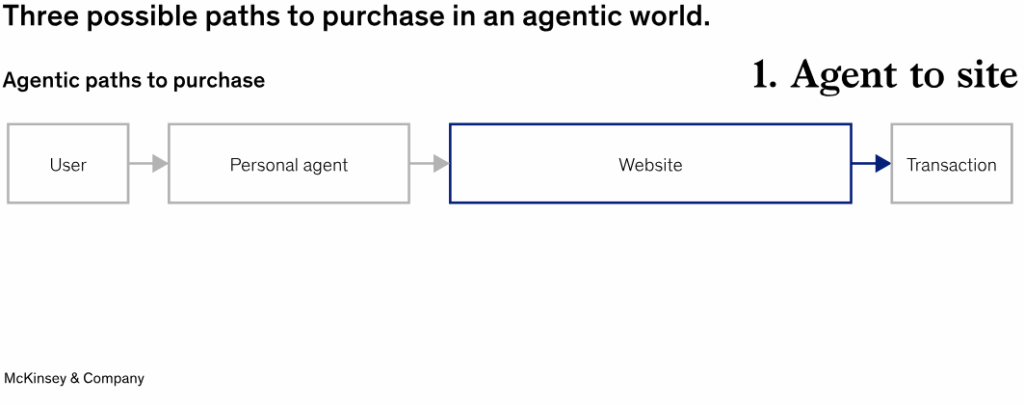
According to McKinsey’s October 2025 report on “agentic commerce,” we’re heading into an era where AI agents act like personal shopping assistants for consumers. These smart helpers can anticipate needs, handle complex purchasing decisions, negotiate deals, and even complete transactions all on their own [3]. Imagine a family moving across the country – an AI agent manages everything: finding a new home, selling old furniture, coordinating movers, and sourcing new purchases. What used to be overwhelming and scattered now becomes smooth, tailored, and stress-free.
This new way of shopping relies on three main interaction models:
1. Agent-to-Site: The AI communicates directly with online stores.
2. Agent-to-Agent: AI agents negotiate with each other – like bundling discounts or arranging deals.
3. Brokered Agent-to-Site: Platforms act as intermediaries, helping agents connect with merchants safely and efficiently.
This shift is made possible by emerging standards like the Model Context Protocol (MCP), which helps agents work together smoothly and securely. For businesses, this means they need to rethink their platforms to be “agent-ready” and explore new ways to engage customers and grow revenue.
(Video: Buy it in ChatGPT: Instant Checkout and the Agentic Commerce Protocol)
Revolutionizing B2B Sales with Specialized AI Agents
In the business-to-business world, AI agents are making sales smarter and more efficient. A BCG report from October 2025 describes an ecosystem of five specialized agents working together to drive growth [7]:
Orchestration Agents: Oversee the entire sales process.
Lead Generation Agents: Find and evaluate potential clients.
Qualification Agents: Decide which leads are worth pursuing and suggest solutions.
Deal & Pricing Agents: Craft proposals and help close deals faster.
Customer Success Agents: Ensure clients are happy, help them get value, and spot opportunities to grow accounts.
This tailored setup lets companies use AI differently depending on the size and complexity of the client. For large, strategic accounts, agents support human sales teams with planning and management. For smaller or transactional deals, AI can operate independently – reaching out to more prospects at scale and serving customers that were previously too costly to target. In doing so, organizations can unlock new growth, improve efficiency, strengthen relationships with key clients, and expand their reach in the wider market.
The influence of AI agents isn’t limited to business — it’s making waves in healthcare and science, opening up exciting possibilities to speed up discoveries, improve patient care, and tackle some of the world’s biggest challenges.
Video: Shaping the Future of Work With Agentic AI
A Look Inside GE HealthCare’s AI Innovation Lab
GE HealthCare’s 2025 AI Innovation Lab, announced in October 2025, offers a glimpse of what’s possible in medicine today [8]. Confronted with a shortage of radiologists and soaring imaging demands, GE is developing what they call the industry’s first agentic AI diagnostic assistant. This isn’t just about analysing images – it’s about working alongside radiologists, helping process scans, communicate naturally, and generate interactive reports. The aim is to make workflows smoother so doctors can spend more time with patients.
One exciting project involves using AI to review incidental findings – those unexpected issues that show up in scans. Nearly half of all abdominal CT scans reveal such findings, and this AI tool is designed to flag high-risk lesions, classify them, and suggest the next steps—like recommending a follow-up MRI—while still keeping radiologists in control. This can significantly boost early detection and improve diagnoses.
The Agentic Future Is Here to Stay
The stories and research from late 2025 make one thing clear: we’re entering an era where AI agents will reshape almost every aspect of our lives – be it business, healthcare, or science. They’re driving automation, boosting efficiency, and fueling innovation like never before.
But success isn’t guaranteed. The Cisco report highlights a major hurdle called “AI Infrastructure Debt” – the lack of flexible, scalable, and secure foundations needed to support these advanced systems [1]. The lesson from early pioneers is that thriving in this new age requires a strategic, all-in approach: investing in robust infrastructure, security, and talent; treating AI as a collaborative partner rather than a threat; and building systems based on trust and transparency.
Those organizations that act decisively now, focusing on thoughtful integration rather than hasty automation, will be the ones defining the future. The pace of change will only accelerate, and the companies that embrace this shift today will be the leaders tomorrow.
References
[1] Cisco. (2025, October 14). Cisco AI Research: The Most AI-ready Companies Outpace Peers in the Race to Value. https://newsroom.cisco.com/c/r/newsroom/en/us/a/y2025/m10/cisco-ai-research-the-most-ai-ready-companies-outpace-peers-in-the-race-to-value.html
[2] Gartner. (2025, October 7). Gartner Says Agentic AI Supply Exceeds Demand, Market Correction Looms. https://www.gartner.com/en/newsroom/press-releases/2025-10-07-gartner-says-agentic-ai-supply-exceeds-demand-market-correction-looms
[3] McKinsey & Company. (2025, October 17). The agentic commerce opportunity: How AI agents are ushering in a new era for consumers and merchants. https://www.mckinsey.com/capabilities/quantumblack/our-insights/the-agentic-commerce-opportunity-how-ai-agents-are-ushering-in-a-new-era-for-consumers-and-merchants
[4] Boston Consulting Group. (2025, October 13). How Agentic AI is Transforming Enterprise Platforms. https://www.bcg.com/publications/2025/how-agentic-ai-is-transforming-enterprise-platforms
[5] TTMS. (2025, November 3). From AI Assistants to Coworkers: The Future of Enterprise AI. https://ttms.com/ai-copilots-vs-ai-coworkers-how-autonomous-agents-are-reshaping-enterprise-strategy-in-2025/
[6] Forbes. (2025, November 3). AI Agents Work When You Automate Tasks, Not Entire Jobs. https://www.forbes.com/sites/charlestowersclark/2025/11/03/ai-agents-work-when-you-automate-tasks-not-entire-jobs/
[7] Boston Consulting Group. (2025, October 14). How AI Agents Will Transform B2B Sales. https://www.bcg.com/publications/2025/how-ai-agents-will-transform-b2b-sales
[8] GE HealthCare. (2025, October 20). GE HealthCare unveils 2025 AI Innovation Lab research projects aimed at accelerating healthcare solutions. https://www.gehealthcare.com/about/newsroom/press-releases/ge-healthcare-unveils-2025-ai-innovation-lab-research-projects-aimed-at-accelerating-healthcare-solutions
[9] Science News. (2025, October 24). A conference just tested AI agents’ ability to do science. https://www.sciencenews.org/article/science-conference-test-ai-agents